The Commercial Real Estate Capital Stack Explained
Also available on the Creative Global Funding Services website.
A commercial real estate project can have a strong location, a credible business plan, and an experienced sponsor—and still face a financing gap. Bringing the transaction together requires understanding how different sources of capital work alongside one another.That financing structure is called the commercial real estate capital stack.
For property owners, developers, and investors, the capital stack explains more than where the money comes from. It helps determine who gets paid first, who absorbs losses, and how much control each participant has over the investment.
This guide explains the main capital layers, illustrates them with a hypothetical $10 million project, and outlines the questions to consider before choosing a financing structure.
What Is a Commercial Real Estate Capital Stack?
The commercial real estate capital stack is the combination of debt and equity used to finance a property acquisition, development, renovation, or refinancing.
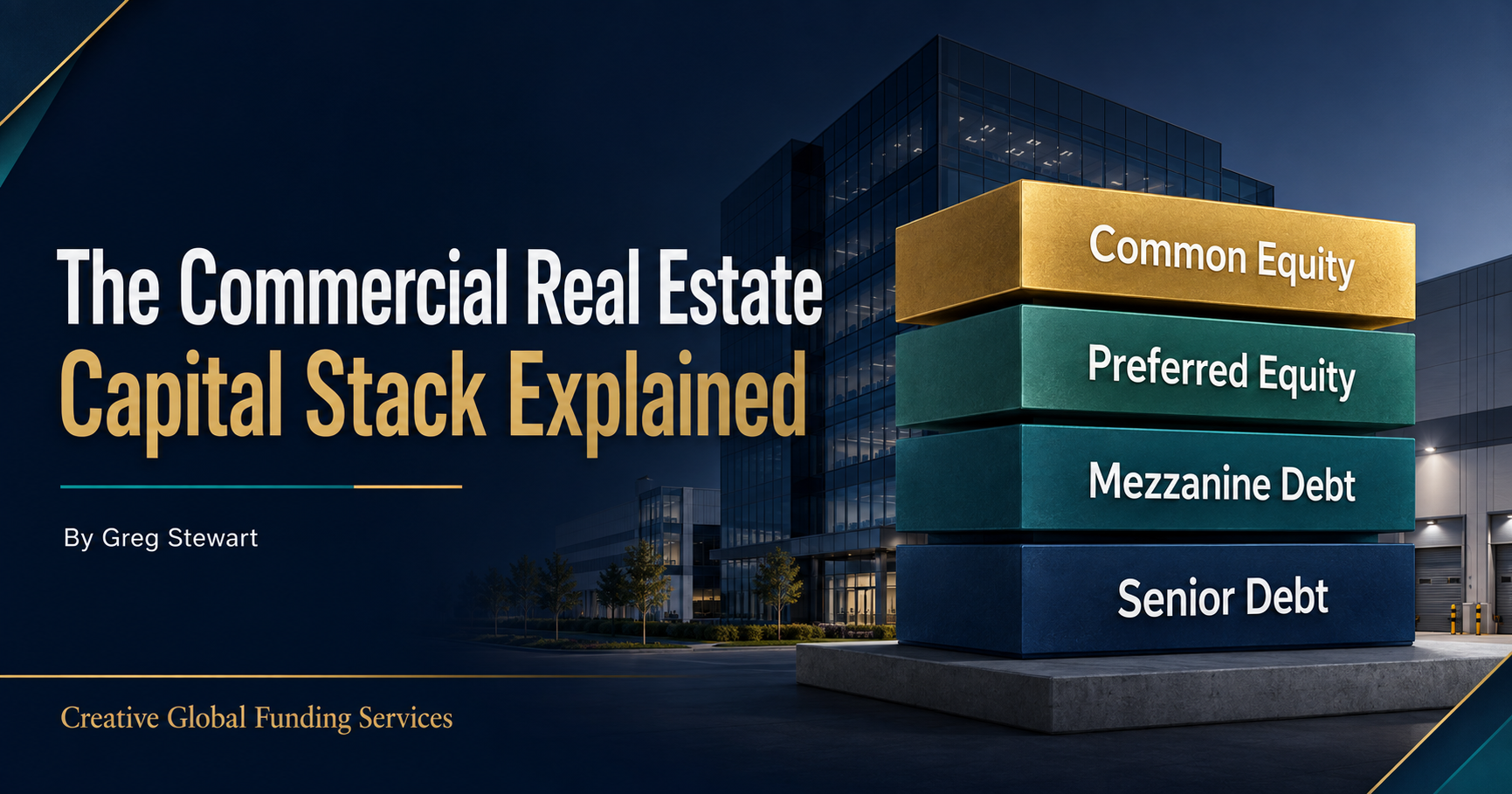
A typical framework includes four layers:
• Senior debt.
• Mezzanine debt.
• Preferred equity.
• Common equity.
Each layer has a different position in the repayment hierarchy. Not every transaction uses all four; a property may be financed with only a senior mortgage and common equity. JPMorganChase’s capital stack overview (https://www.jpmorgan.com/insights/real-estate/commercial-term-lending/what-is-a-capital-stack-in-real-estate).
The central principle is straightforward: capital with greater repayment priority generally accepts a lower expected return, while capital exposed to earlier losses generally seeks a higher return. Actual risk also depends on leverage, collateral, contractual protections, and property performance. CBRE Investment Management’s real estate credit overview (https://www.cbreim.com/-/media/project/cbre/bussectors/cbreim/insights/articles/perspectives-case-for-us-real-estate/case-for-us-real-estate-credit-perspective.pdf).
The Four Main Layers of the Capital Stack
The overview below shows a simplified structure, ordered from highest to lowest repayment priority among these four capital sources.
Senior debt: Basic structure: Loan secured by a first mortgage or equivalent property security; Typical economic position: Paid before subordinate financing and equity.
Mezzanine debt: Basic structure: Subordinate loan, commonly secured by ownership interests; Typical economic position: Behind senior debt and ahead of equity.
Preferred equity: Basic structure: Ownership interest with negotiated preferences; Typical economic position: Ahead of common equity distributions.
Common equity: Basic structure: Residual ownership capital; Typical economic position: Receives remaining proceeds and generally absorbs losses first.
This is an educational framework. Entity structure, transaction documents, and applicable law determine actual rights and priorities.
1. Senior Debt: The Primary Loan
Senior debt commonly provides the largest individual funding component. It can take the form of an acquisition loan, construction facility, bridge loan, or longer-term mortgage.
The lender receives contractual interest and principal payments and typically holds a first-ranking security interest in the property. This priority offers greater protection relative to the layers beneath it, although it does not eliminate the possibility of loss.
For a sponsor—the person or company organizing the investment—the practical questions extend beyond the interest rate:
• How much financing will the lender provide?
• When does the loan mature?
• What reserves and guarantees are required?
• Can the loan be prepaid?
• Does the lender permit additional debt or preferred equity?
The senior loan’s restrictions can shape the rest of the financing structure. CBRE Investment Management (https://www.cbreim.com/-/media/project/cbre/bussectors/cbreim/insights/articles/perspectives-case-for-us-real-estate/case-for-us-real-estate-credit-perspective.pdf).
2. Mezzanine Debt: Subordinate Financing
Mezzanine financing can help address a gap between senior loan proceeds and available equity.
In a common U.S. commercial real estate structure, the mezzanine lender lends to an owner of the property-owning borrower and takes a pledge of ownership interests. This differs from a second mortgage directly secured by the property.
The relationship between senior and mezzanine lenders is typically addressed through an intercreditor agreement. It can establish rights concerning defaults, enforcement, cure periods, and transfers of control.
Sponsors should assess both the added payment burden and the consequences of a default before adding this layer. American Association of Private Lenders’ explanation of mezzanine debt (https://aaplonline.com/articles/operations/understanding-mezzanine-debt-and-key-intercreditor-issues/).
3. Preferred Equity: Priority Within the Ownership Structure
Preferred equity is an ownership investment with negotiated priority over common equity.
Depending on the agreement, preferred investors may receive a preferred return, priority in recovering invested capital, or participation in additional profits. Their position remains behind debt obligations in a conventional structure.
A preferred return does not guarantee that cash will be available for payment. Sponsors should examine whether unpaid returns accumulate and what rights investors receive if agreed milestones are missed. JPMorganChase (https://www.jpmorgan.com/insights/real-estate/commercial-term-lending/what-is-a-capital-stack-in-real-estate).
4. Common Equity: The Residual Ownership Capital
Common equity typically comes from the sponsor, outside investors, or joint venture partners.
Common investors receive the proceeds remaining after obligations to higher-ranking capital providers have been satisfied. They generally bear the first economic losses when a project’s value declines, but may benefit substantially when it performs well.
The allocation of profits among common equity investors depends on the ownership agreement and distribution waterfall. PropertyMetrics’ capital stack explanation (https://propertymetrics.com/blog/capital-stack/).
Commercial Real Estate Capital Stack Example: A $10 Million Project
Assume a sponsor needs $10 million to acquire and improve a commercial property. The total budget includes purchase costs, planned improvements, transaction expenses, and reserves.
A hypothetical financing structure could be:
Senior debt: Amount: $6,000,000; Share of total project cost: 60%.
Mezzanine debt: Amount: $1,000,000; Share of total project cost: 10%.
Preferred equity: Amount: $1,000,000; Share of total project cost: 10%.
Common equity: Amount: $2,000,000; Share of total project cost: 20%.
Total: Amount: $10,000,000; Share of total project cost: 100%.
These figures illustrate the structure; they are not market terms or a financing offer.
The project has $7 million of debt and $3 million of equity. The preferred equity remains equity, even if its negotiated return creates a significant cash requirement.
What Happens if the Property Loses Value?
Suppose the project is sold and $8.5 million is available for distribution after selling costs and any claims outside this simplified stack.
For this example only, assume:
• Both loans retain their original principal balances.
• All interest and preferred returns have already been paid.
• No additional fees, penalties, or claims remain.
• Preferred capital is returned before common capital.
The proceeds would be allocated as follows:
Senior lender: Original capital: $6,000,000; Capital recovered: $6,000,000.
Mezzanine lender: Original capital: $1,000,000; Capital recovered: $1,000,000.
Preferred equity investor: Original capital: $1,000,000; Capital recovered: $1,000,000.
Common equity investors: Original capital: $2,000,000; Capital recovered: $500,000.
Total: Original capital: $10,000,000; Capital recovered: $8,500,000.
The $1.5 million shortfall falls entirely on common equity in this example. Common investors recover just 25% of their original capital.
At lower proceeds, losses would begin affecting the preferred equity and then the debt layers under these assumptions.
Capital Stack vs. Distribution Waterfall
The capital stack identifies the funding sources and their relative positions. The distribution waterfall specifies how available cash is allocated.
A waterfall may address preferred returns, return of invested capital, and profit sharing after negotiated performance thresholds. Operating cash flow and sale proceeds may follow different distribution provisions.
For example, two projects could each have 70% debt and 30% equity but allocate profits very differently among their equity investors.
Evaluating the percentages alone therefore provides an incomplete picture of the economics.
Key Metrics for Evaluating a Capital Stack
Loan-to-Value Ratio: Debt Compared With Property Value
Loan-to-value ratio (LTV) = Loan amount ÷ Property value × 100
If the example property has an independently supported value of $12 million:
• Senior LTV is $6 million ÷ $12 million = 50%.
• Total debt relative to value is $7 million ÷ $12 million = 58.3%.
Always identify which debt layers and valuation basis a quoted ratio includes.
Loan-to-Cost Ratio: Debt Compared With Project Cost
Loan-to-cost ratio (LTC) = Loan amount ÷ Total project cost × 100
Using the $10 million project budget:
• Senior LTC is 60%.
• Total debt relative to project cost is 70%.
Value and cost are different denominators. A project’s cost-based funding percentages should not automatically be presented as its LTV.
Debt Service Coverage Ratio: Income Compared With Debt Payments
Debt service coverage ratio (DSCR) = Annual net operating income ÷ Annual debt service
If annual net operating income is $900,000 and annual debt service is $720,000:
DSCR = 1.25x
The property generates $1.25 of net operating income for every $1.00 of debt service. Lenders apply their own underwriting definitions and requirements; no single threshold fits every transaction. JPMorganChase’s DSCR guide (https://www.jpmorgan.com/insights/real-estate/commercial-term-lending/what-is-debt-service-coverage-ratio-dscr-in-real-estate).
When reviewing a layered structure, specify whether the calculation includes senior debt alone or all debt payments. Assess preferred equity cash requirements separately as well.
How to Assess a Proposed Financing Structure
A useful starting point is to test whether the property can support the entire structure under realistic operating conditions.
Build a complete project budget. Include financing expenses, construction contingencies, leasing costs, reserves, and the cash needed before stabilization.
Compare the full economic cost. Interest rates alone exclude origination fees, exit fees, accrued returns, and equity participation. Model the dollars payable throughout the expected holding period.
Test a downside scenario. Recalculate available cash and exit proceeds with lower occupancy, slower leasing, higher expenses, or a delayed sale.
Check the timing of obligations. Put loan maturities, extension conditions, and preferred equity redemption provisions on the same timeline. A project may need additional capital if obligations fall due before the business plan is complete.
Review decision-making rights. Identify who must approve refinancing, a sale, additional borrowing, budget changes, and new capital contributions.
Prepare an alternative exit. Test what happens if refinancing proceeds are insufficient to repay existing obligations. Quantify the potential equity contribution instead of assuming future financing will close the gap.
These checks help turn a proposed capital stack into a financing plan that can be evaluated.
Preparing a Commercial Real Estate Funding Request
A clear funding package helps potential capital providers understand both the opportunity and the requested structure.
Prepare:
• A project summary, location, and property description.
• A detailed sources-and-uses budget.
• Current financial information and operating projections.
• Existing debt balances, maturities, and material restrictions.
• Sponsor experience and available equity.
• Valuation support and the proposed exit strategy.
• Construction budgets, schedules, permits, and leasing information where applicable.
Creative Global Funding Services reviews commercial real estate opportunities involving acquisition, development, construction, and refinancing. Explore our commercial financing solutions (https://www.creativeglobalfundingservices.com/solutions.php) to learn more.
Frequently Asked Questions
Does every commercial real estate deal need all four capital layers?
No. Senior debt and common equity may be sufficient. Additional layers introduce costs and contractual requirements, so their usefulness depends on the transaction.
What is the difference between mezzanine debt and preferred equity?
Mezzanine debt is a loan, commonly secured by pledged ownership interests. Preferred equity is an ownership investment with negotiated distribution and other contractual rights. The documents determine their specific protections and remedies.
Is preferred equity the same as a preferred return?
No. Preferred equity describes an investment position. A preferred return describes a distribution entitlement that can also appear within an ordinary joint venture equity waterfall.
How much equity does a commercial real estate project require?
There is no universal percentage. The requirement depends on property cash flow, valuation, project costs, sponsor strength, lender restrictions, and the proposed financing structure.
Does adding more debt improve investor returns?
It can improve equity returns when performance supports the additional financing cost. It can also magnify losses and leave less cash available during periods of weaker performance.
Discuss Your Commercial Real Estate Funding Needs
An effective capital stack supports the project’s budget, operating plan, and repayment strategy while setting clear expectations for lenders and investors.
Creative Global Funding Services connects qualified businesses, sponsors, and project owners with private lenders, institutional investors, family offices, and alternative capital providers. We review funding requests of USD $1 million or more.
Planning an acquisition, development, or refinancing? Submit your funding request (https://www.creativeglobalfundingservices.com/request-funding.php) with your project details, capital requirements, and available equity to begin the review process.
Funding is subject to capital-provider underwriting, due diligence, acceptable documentation, and final approval.
Discuss your project on WhatsApp: Message Creative Global Funding Services.


Comments
Post a Comment